Do You Need Planning Permission for a Heat Pump in Bristol?
Last reviewed: 2 October 2026
Most Bristol heat pumps need no planning application. The exceptions cluster in the city's 33 conservation areas and its many listed buildings. Here is how to tell which side of the line your home falls on.
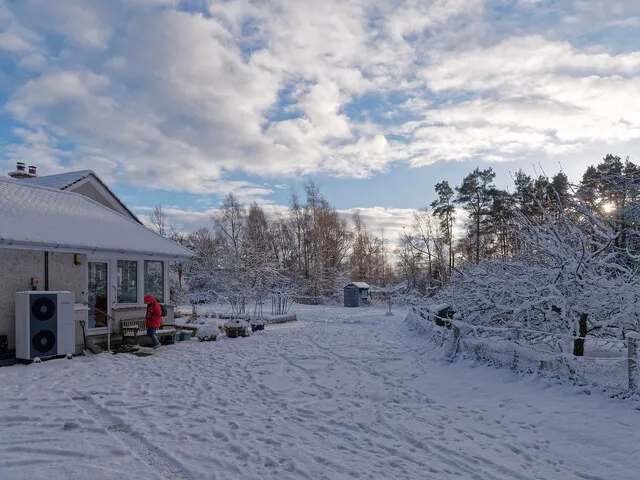
The general rule in England
An air source heat pump at a house is normally permitted development, meaning you don’t need to apply for planning permission. The right comes from Class G of Part 14 of the General Permitted Development Order. It was widened by an amendment that came into force on 29 May 2025, which removed the old rule that a unit had to sit at least a metre from your boundary.
To count as permitted development, the installation must meet these conditions:
- Size: the outdoor unit is no bigger than 1.5 cubic metres. Domestic units are comfortably below this.
- Number: one unit, or two on a detached house.
- Position: not on a pitched roof, and not within a metre of the edge of a flat roof.
- Noise: an MCS 020(a) calculation shows no more than 37 dB(A) at the nearest neighbouring habitable room window.
- Use: it’s used only for heating and hot water, and removed when no longer needed.
Where Bristol is different
Bristol has 33 conservation areas covering roughly 30% of the city, and a very large number of listed buildings, especially in Clifton, Kingsdown, Cotham and the old centre. These change the rules.
Conservation areas
Permitted development still applies in a conservation area, with one extra condition: the unit must not be on a wall or roof that faces a highway. In practice:
- Back garden, rear wall or side return not facing the road: usually still permitted development.
- Front wall, or a side wall facing a street on a corner plot: needs planning permission.
Conservation areas covering many Bristol homes include Clifton (designated 1972), Cotham and Redland (1981), Westbury-on-Trym (1971) and Sneyd Park (1981).
Article 4 directions
Some Bristol conservation areas have Article 4 directions, which remove specific permitted development rights. Cotham and Redland, for example, has one covering boundary walls. An Article 4 direction doesn’t automatically catch heat pumps, but if your installation involves altering a front boundary wall, or your street is covered by a wider direction, check with Bristol City Council’s planning team before work starts.
Listed buildings
If your home is listed, permitted development does not apply to work on the building or within its curtilage. You’ll need listed building consent for the outdoor unit, the pipe routes through historic walls, and sometimes the internal work too. There’s no fee for listed building consent, but expect a decision to take at least eight weeks.
Bristol’s terrain and siting
Bristol’s hills make siting decisions more interesting than in a flat city:
- Terraced gardens on slopes, common in Totterdown, Windmill Hill and Clifton Wood, may need a level base built into the bank. That’s a building matter, not usually a planning one.
- Shared rear lanes behind many Victorian terraces can’t be used to site a unit unless you own the land.
- Basements and cellars, found in many Clifton and Cotham townhouses, can house the cylinder and controls, keeping pipe runs short and out of sight.
None of these change the planning rules, but they affect where the unit can go and therefore whether it ends up facing the road.
The noise test in tight terraces
The 37 dB limit is measured at your neighbour’s nearest window, not at the boundary. In a Bedminster or Southville terrace with back yards a few metres wide, that can be the deciding factor. Your installer can usually meet it by:
- choosing a quieter model
- positioning the unit further from neighbouring windows
- adding a solid barrier between the unit and the assessment point
If the calculation can’t be met, the installation can still go ahead with a full planning application, but permission isn’t guaranteed.
If you do need permission
- Your installer prepares a site plan, unit specification and noise assessment.
- You submit a householder application to Bristol City Council, usually through the Planning Portal, with the fee.
- The council consults neighbours and decides, normally within eight weeks.
For listed buildings, a listed building consent application runs alongside (or instead of) planning permission. Conservation officers in Bristol generally support low-carbon heating where the unit is discreetly placed. A rear or side position, a muted colour and a low-profile unit help.
Get consent before the grant is applied for. A Boiler Upgrade Scheme voucher for an air source heat pump has a limited life, and you don’t want it expiring while you wait for a decision. See how to apply for the grant.
Quick checklist for a Bristol home
- Is the house listed? → listed building consent needed
- Is it in one of the 33 conservation areas? → avoid walls and roofs facing a road
- Is there an Article 4 direction affecting the work? → check with the council
- Does the noise calculation pass at 37 dB? → otherwise a planning application
- Flat rather than house? → permitted development rules are narrower; ask the installer to check
More on older homes: heat pumps in Victorian houses.
See what a heat pump would look like in your Bristol home
The mechanism is the same in every UK home; the design is specific to yours. Our team carries out a free in-home survey including a full room-by-room heat-loss calculation, identifies the system size and configuration that fits your property, and provides a written quote with the £7,500 BUS grant already deducted.
You'll see the actual figure you'd pay — not an estimate — and the projected efficiency for your specific install.